Federal Pacific, Zinsco & Challenger Panels: Why Insurers Flag Them
Quick answer: Insurance companies flag Federal Pacific (Stab-Lok), Zinsco, and some Challenger panels because these brands are obsolete and have documented problems with breakers that may not trip during an overload or short circuit. A breaker that doesn't trip can't protect your wiring from overheating.
Many carriers now require homeowners to have a licensed electrician evaluate or replace the panel before they'll write or renew a policy.
If you've just received a letter from your insurer, or a home inspector circled your panel on a report, you're not alone.
Many homes across Cincinnati and Northern Kentucky were built between the 1950s and 1980s, when these panels were installed. Here's what's actually wrong with them, how to tell what you have, and what your options are.
Why Your Electrical Panel Matters to Your Insurer
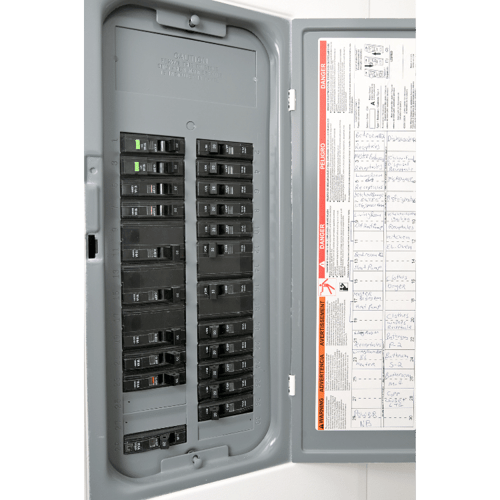
Your electrical panel has one main safety job: when a circuit draws more current than its wiring can safely handle, the breaker trips and cuts the power. If that breaker doesn't trip, the wire keeps heating up inside your walls.
Insurers pay fire claims, so they pay close attention to equipment with a track record of not doing that job. Their decision isn't always about your panel's condition — often, the brand name on the door triggers the underwriting flag.
Federal Pacific Electric (FPE) Stab-Lok Panels
Installed: Millions of homes and businesses between roughly 1950 and 1985, according to Hanover Insurance's risk guidance.
How to spot one: The panel door or label says "Federal Pacific," "FPE," or "Stab-Lok." The breakers are usually narrow with red-tipped toggles.
What's wrong with them:
- In 1980, the company that had purchased FPE reported to the U.S. Consumer Product Safety Commission that many FPE breakers did not fully comply with Underwriters Laboratories (UL) requirements. CPSC testing confirmed that certain breakers failed UL calibration tests — the tests that check whether a breaker trips on time during an overload.
- Testing by the CPSC and independent engineers found some Stab-Lok breakers could jam in the "on" position, along with overheating problems at the panel's internal bus connections, per Hanover.
- A 2002 New Jersey court decision found the manufacturer had committed fraud by applying UL labels to breakers it knew did not meet UL testing requirements (Hanover).
A fair note on the record: The CPSC closed its investigation in 1983 without making a determination either way about FPE breaker safety, largely because a full study would have cost several million dollars (CPSC). There was never a formal recall. That's why you'll see conflicting information online. But Hanover's guidance is direct: when an FPE Stab-Lok installation is found, the safest course is a completely new panel and breakers.
Zinsco and Sylvania-Zinsco Panels
Installed: Common in homes built through the 1970s. Zinsco was sold to GTE Sylvania in 1973, and panels continued to carry the Zinsco name in some form, according to Great American Insurance Group.
How to spot one: Labels reading "Zinsco," "Sylvania," "Sylvania-Zinsco," or "GTE-Sylvania." Breakers often have brightly colored blue, red, or green handles — but black-handled breakers can be Zinsco too.
What's wrong with them:
- Zinsco breakers attach to the bus bar with an aluminum, horseshoe-shaped clip. As it heats and cools, the clip can lose firm contact and start arcing (Great American).
- The aluminum bus bar can corrode, creating poor connections and more arcing.
- Arcing can melt the breaker and weld it to the bus bar. A welded breaker can't trip — power keeps flowing until the main is shut off or the wire fails.
- A breaker can appear to be off while the panel is still conducting power.
Great American's loss-control team states that these panels would not pass today's UL certification and that all Zinsco breakers and panels should be replaced with current UL-listed equipment (Great American).
Challenger Panels
How to spot one: "Challenger" is typically stamped on the door or printed on the interior label.
What's the concern: Challenger is the one on this list people misunderstand most.
- In 1988, Challenger offered free replacement of about 9,000 Type HAGF 15- and 20-amp GFCI breakers because a mechanical part could detach and disable the ground-fault protection (CPSC). That program covered those specific breakers — not every Challenger panel.
- Challenger also made Zinsco-style replacement breakers, so some Challenger-labeled equipment shares the Zinsco design (Great American).
- Beyond that, Challenger equipment is discontinued, and some carriers treat it like other obsolete panels (Panel Letter).
So a Challenger panel isn't automatically dangerous — but it does need a qualified set of eyes, and it may still trigger an insurance requirement regardless.
How to Check What Panel You Have (Safely)
You can usually identify your panel without touching anything electrical:
- Open only the outer door of the panel. Do not remove the inner metal cover (the dead front) — live parts are behind it.
- Read the label on the inside of the door and any brand name stamped on the door itself.
- Look at the breakers: narrow red-tipped toggles (possible FPE), brightly colored blue/red/green handles (possible Zinsco).
- Take a clear photo of the closed door and the inside label. That's what your electrician and insurer will want to see.
If the label is missing or worn, don't guess. A licensed electrician can identify the equipment in minutes.

Warning Signs You Shouldn't Wait On
Regardless of the brand, call an electrician promptly if you notice:
- A panel cover that feels warm to the touch
- A burning or hot-plastic smell near the panel
- Buzzing, crackling, or sizzling from the panel
- Scorch marks, melted plastic, or discoloration on breakers
- Breakers that won't stay reset — or, just as concerning, a breaker that never trips even when you know a circuit is overloaded
- Lights that dim or flicker throughout the house when large appliances start
What Happens If Your Insurer Flags Your Panel
Every carrier handles this differently, but homeowners in the Tri-State typically see one of these:
- A request for an electrician's evaluation confirming the panel's brand and condition
- A deadline to replace the panel to keep or renew coverage
- Higher premiums until the panel is replaced
- Difficulty getting a new policy when buying a home that has one of these panels
If you're buying or selling, expect the panel to come up in the home inspection. Replacing it before listing removes a common negotiating point.
Ask your insurer exactly what documentation they need — a replacement invoice, a permit sign-off, or a letter from the electrician — so the work closes out the requirement the first time.
Repair or Replace?
With FPE Stab-Lok and Zinsco, individual breaker swaps usually aren't a real fix. The concerns involve the panel design and the bus connections, not just a single worn breaker, and many insurers want the whole panel replaced. For most homes, replacing the panel is the permanent solution.
A panel replacement is also a good moment to address other things that come with an older home:
- Upgrading service capacity (for example, 100 amps to 200 amps) for EV chargers, heat pumps, or a finished basement
- Adding AFCI and GFCI protection where current code requires it
- Installing a whole-house surge protector at the panel
- Checking the meter base, service entrance, and grounding for age-related wear
Why Homeowners Choose Premiere Electric for Panel Replacements
Premiere Electric has served homeowners across Cincinnati, Northern Kentucky, and the Tri-State since 1990. Our fully licensed and insured Master Electricians handle panel inspections, electrical panel upgrades, and whole-house service upgrades — including permits and inspections — so your insurer gets exactly the documentation it's asking for. We do it right the first time, and our Google reviews are all 5 stars.
Schedule a Panel Inspection or Upgrade
Not sure what's in your basement? Got a letter from your insurance company? Let a Premiere Electric Master Electrician take a look. We'll identify your panel, check its condition, explain your options in plain English, and give you a clear quote if replacement makes sense.
Call to schedule your panel inspection or upgrade today:
- Kentucky: 859-635-2376
- Ohio: 513-421-2376