
Is a Crackling or Broken Light Switch Dangerous?
A crackling, buzzing, popping, or warm light switch is a warning sign, not a quirk. These sounds usually mean electricity is arcing — jumping across a loose or worn connection instead of flowing cleanly through it — and arcing generates heat inside your wall where you can't see it.
Left alone, it can scorch wiring, melt switch components, and start a fire. Below, we answer the questions homeowners in the Tri-State area ask us most: what the noises mean, which signs are urgent, what you can safely check yourself, and when to shut off the breaker and call a licensed electrician.
Is a crackling light switch dangerous?
Yes. A crackling or sizzling sound means current is arcing inside the switch. Arcing produces temperatures high enough to char insulation and surrounding wood framing. A switch that crackles is failing — it will not repair itself, and the arcing typically gets worse with each use.
What causes a light switch to crackle or buzz?
Most crackling and buzzing traces back to one of these:
- Loose wire connections. Wires backed out of the screw terminals, or push-in "backstab" connections that have loosened over decades of heating and cooling cycles.
- Worn internal contacts. A standard toggle switch has a mechanical lifespan. After thousands of flips, the contacts pit and no longer close tightly.
- Overloaded circuit. The switch is carrying more current than it's rated for, often after someone added fixtures to the circuit.
- Dimmer and LED mismatch. A dimmer that isn't rated for LED loads can hum or buzz. This is often a compatibility issue rather than a fault, but it still needs verification.
- Aluminum wiring or knob-and-tube. Older wiring systems create high-resistance connections at devices, a common source of arcing in homes built before the mid-1970s.
- Moisture or corrosion. Common in bathrooms, garages, basements, and exterior switch locations.

Is a humming or buzzing switch as serious as crackling?
A steady, low hum from a dimmer usually comes from the dimmer's electronics interacting with the light source, and it's often harmless—though a dimmer rated for your specific LED load will normally solve it. A crackle, sizzle, pop, or intermittent buzz that changes when you touch the switch plate is a different problem entirely. That pattern points to a loose connection and should be treated as urgent.
What are the warning signs a light switch needs immediate attention?
Shut off the circuit breaker and call an electrician if you notice any of these:
- Crackling, sizzling, or popping when you flip the switch
- A switch plate that feels warm or hot to the touch
- A burning, fishy, or acrid plastic smell near the switch
- Brown, yellow, or black scorch marks around the plate or screw holes
- Visible sparks when the switch is operated
- Lights that flicker or dim when the switch is jostled
- A switch that has become loose in the wall or rattles
- A toggle that no longer clicks crisply, or has to be held in position
- Repeated breaker trips on that circuit
- A mild tingle or shock when you touch the plate — this is an emergency
Is a broken light switch dangerous even if the lights still work?
It can be. "Broken" covers several conditions, and the risk depends on which one you have. A cracked cover plate exposes live terminals to fingers and dust. A switch that sticks between on and off may leave the contacts partially closed, which is exactly what produces arcing.
A switch that's loose in the box lets wires flex and eventually work free. In each case, the lights working is not evidence that the wiring behind the switch is safe.
Why does my light switch spark when I turn it on?
A brief, faint blue flash inside older switches can occur as contacts separate, but visible sparking at the switch plate, sparks accompanied by a snap, or consistent sparking indicates a failing switch or loose conductor. Don't keep using it to see whether it happens again. Each spark event adds heat damage to the connection.
Can a bad light switch start a fire?
Yes. Arcing at a device connection is a recognized ignition source for electrical fires. The danger is that the damage accumulates inside a closed wall cavity, surrounded by framing, insulation, and sometimes dust — all combustible. There's rarely a dramatic warning before ignition, which is why the small signs (warmth, smell, crackle) matter so much.
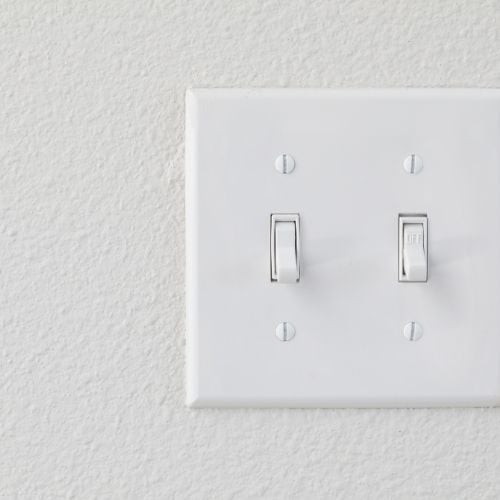
Can I fix a crackling light switch myself?
We don't recommend it. Replacing a switch looks simple, but the crackle is a symptom, and the actual fault is often in the connection or the circuit rather than the device. Swapping in a new switch while reusing a loose backstab connection or an overloaded circuit recreates the same hazard behind a new cover plate. You also need to correctly identify single-pole, three-way, four-way, and dimmer configurations, match the switch to the load, and verify grounding.
If you want to make things safer while you wait for an appointment: turn off the breaker controlling that switch, leave it off, and don't use the circuit.
What will an electrician actually do?
A proper diagnosis includes:
- De-energizing the circuit and confirming it's dead with a tester
- Removing the device and inspecting the conductors for scorching, nicking, or overheating
- Checking the wiring method — copper, aluminum, knob-and-tube — and the box fill
- Verifying the circuit load and breaker sizing
- Replacing the switch with a device correctly rated for the load, using screw terminals rather than push-in connections
- Inspecting adjacent devices on the same circuit, since arcing is often not isolated to one location
When is it time to upgrade instead of repair?
If your home has original wiring from before the 1970s, multiple switches and outlets are showing symptoms, your panel still uses fuses, or you're finding cloth-insulated or knob-and-tube wiring, the switch is telling you something about the system as a whole. In those homes, targeted rewiring or a service and panel upgrade addresses the root cause rather than the symptom.
How can I prevent switch problems?
- Replace switches that have been in service for decades, even if they still work
- Use screw-terminal connections rather than push-in backstabs
- Match dimmers to the specific lamps you're installing
- Don't add fixtures to a circuit without confirming capacity
- Address flickering promptly instead of getting used to it
- Have arc-fault circuit interrupter (AFCI) protection installed — AFCIs are specifically designed to detect the arcing signature that causes these fires