
Quick Summary
- Bathrooms require GFCI protection, not AFCI, per NEC Section 210.8(A)(1).
- GFCI stops electric shock by detecting a 4–6 mA current imbalance and tripping in about 1/40 of a second.
- AFCI stops electrical fires by detecting arcing in damaged wiring and is required in bedrooms, living rooms, and similar habitable spaces.
- Kitchens and laundry areas often need both, sometimes via a dual-function breaker.
- You can identify a GFCI breaker at your panel by its distinct test button color (commonly yellow) and a "push to test" button on its face.
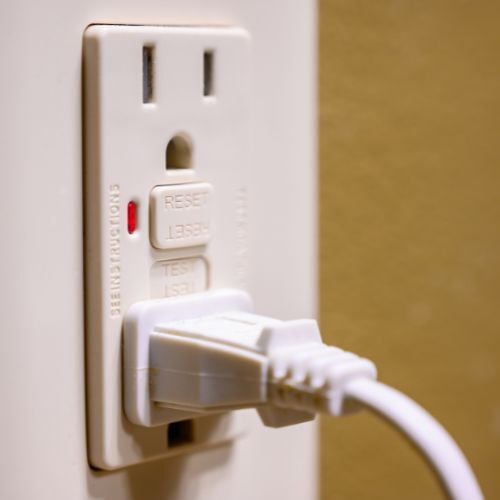
- GFCI outlets are recognizable by the Test and Reset buttons on the receptacle face itself.
How to Check If Your Circuit Breaker Has GFCI Protection
How do I identify a GFCI breaker just by looking at my panel?
Open your panel door and look for a breaker with a built-in test button on its face — most GFCI breakers have this button in addition to the normal on/off switch, and manufacturers like Square D commonly use a yellow test button for GFCI-only breakers. Color coding varies by brand: Square D uses white or green for AFCI, yellow for GFCI, and purple or blue for dual-function breakers, while Siemens, Eaton/Cutler-Hammer, and GE use their own schemes, often red or white.
What if there's no visible test button on any breaker?
That likely means your bathroom (or other wet-area) outlets are protected by a GFCI receptacle rather than a GFCI breaker. Check the outlets themselves for a small "Reset" and "Test" button on the face of the receptacle — if you see one, that outlet (and possibly others wired downstream of it) has GFCI protection.
How can I trace which breaker protects a specific GFCI outlet?
Plug a lamp or small device into the outlet in question, then go to the panel and flip breakers off one at a time until the lamp loses power — the breaker you just switched off is the one protecting that circuit. Alternatively, a combination circuit breaker finder with a GFCI test function can locate it electronically without any guesswork, which is useful if you have a large panel.
Is there fine print on the breaker that confirms its type?
Yes. Most breakers have small printed text — "GFCI," "CAFCI," or "AFCI" — on the face, though it may require a magnifying glass and, on some Square D models, is hidden behind the removable dead front cover that shouldn't be removed without an electrician.
How do I test a GFCI breaker or outlet once I've found it?
Press the "Test" button on the breaker or outlet — the power should cut off immediately to anything plugged in or wired downstream. Then press "Reset" to restore power; if the device doesn't trip on test or won't hold after reset, it has failed and needs replacement by a licensed electrician.
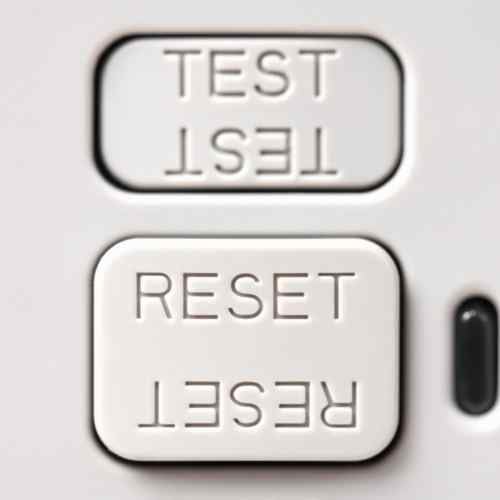
Perform this test monthly to confirm the device is still functioning.
GFCI Breaker vs. GFCI Outlet: What's the Difference?
|
|
GFCI Outlet |
GFCI Breaker |
|
Location |
At the wall receptacle |
At the main panel |
|
What it protects |
The outlet itself plus downstream outlets wired to its LOAD terminals |
The entire branch circuit, including wiring inside the walls |
|
Reset location |
On the outlet face |
At the panel |
|
Typical cost |
Lower per device |
Higher per device, requires panel access |
|
Best for |
Single bathroom, kitchen, or outdoor location |
Hardwired equipment or multiple outlets on one long circuit |
Frequently Asked Questions
Is a GFCI outlet the same thing as a GFCI breaker?
No. Both provide the same trip protection at the same 4–6 mA threshold, but a GFCI outlet protects only itself and outlets wired downstream of it, while a GFCI breaker protects the entire circuit from the panel, including the wiring inside the walls.
Can I install a GFCI outlet on a circuit that already has an AFCI breaker?
Yes, this is common and not redundant — the AFCI breaker watches for arc faults in the wiring, while the GFCI outlet independently watches for ground faults at that specific location, so together they cover two different hazards.
Do all bathroom outlets need to be GFCI, or just the one near the sink?
All bathroom receptacles rated 125–250 volts require GFCI protection under NEC 210.8(A)(1), with no exception based on distance from water. This also covers any outlet within 6 feet of a bathtub or shower, even outside the bathroom itself.
What color is a GFCI breaker's test button?
It depends on the brand — there's no universal standard. Square D commonly uses yellow for GFCI-only breakers, purple for dual-function GFCI/AFCI, and white or green for AFCI-only; other manufacturers like Siemens and Eaton often use red or white.
Should I upgrade my bathroom to a combination AFCI/GFCI breaker even though only GFCI is required?
Some electricians recommend it as best practice, since it adds fire protection on top of the code-required shock protection, though the NEC does not mandate it for bathrooms. We recommend you schedule an inspection before making any decisions.
How often should I test my GFCI device?
Once a month. Press the test button to confirm the device trips and cuts power, then press reset to restore it — if it fails to trip or won't reset, replace it immediately.

.jpg)